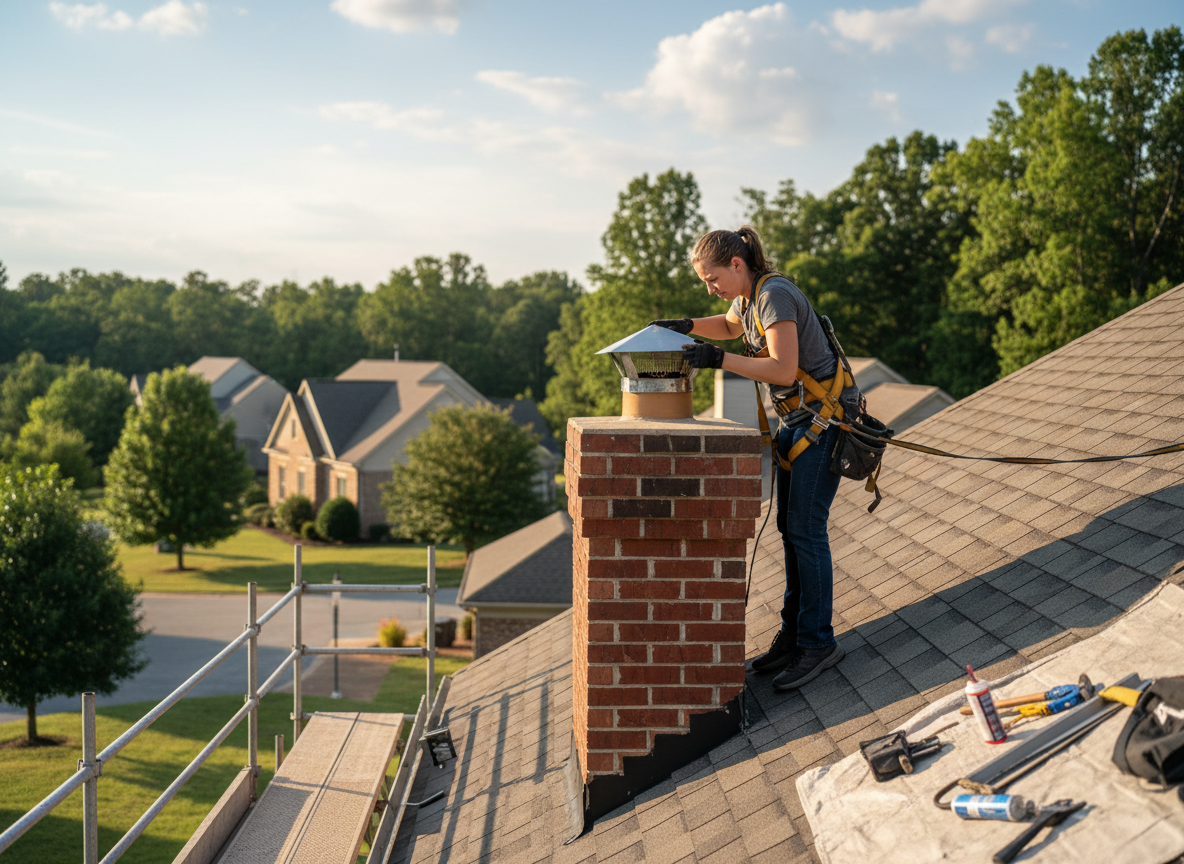
Mint Hill sits in Mecklenburg County just east of Charlotte, where hot humid summers and occasional winter freezes accelerate rust on chimney caps. Homes in neighborhoods like Bainbridge and The Farm at Mint Hill often date from the 1980s through early 2000s and commonly have masonry chimneys topped with galvanized or thin stainless caps that were never upgraded for local wind loads or driving rain. When these caps fail, water enters the flue, damages the crown, and can reach the attic or living spaces below. We see this pattern repeatedly on properties near Mint Hill Veterans Memorial Park where mature trees funnel gusts directly onto roofs.
Cap repair here requires matching the existing flue size and spark arrestor mesh while upgrading to heavier-gauge stainless to resist corrosion. Edge cases include caps on two-story homes with steep pitches where scaffolding or roof anchors are needed, and older installations where the original flashing has pulled away from the crown mortar. Mecklenburg County does not require a permit for simple cap replacement, but the work must still meet manufacturer torque specs on the anchor screws so the assembly survives summer thunderstorms. Skipping proper sealing around the flue tile often leads to repeat leaks within one season.
Access challenges arise on properties with low-slope additions or those backed up to wooded lots common in The Farm at Mint Hill. We always verify the chimney is drawing correctly after the new cap is installed because a restricted opening can push smoke back into the home during the mild winter burn season. Homeowners who wait until visible rust stains appear on the exterior brick usually face more extensive crown work once the cap is removed.
Technician insight
In Mint Hill, the thing that catches most people out with chimney cap repair is how quickly summer humidity and occasional freeze-thaw cycles eat through the original galvanized caps on 1980s-1990s homes in Bainbridge and The Farm at Mint Hill, especially when trees channel wind straight at the chimney.
Rusted Cap Causing Attic Leaks
A homeowner in The Farm at Mint Hill reported water stains in the attic after heavy summer rains. We found the original galvanized cap rusted through with missing mesh. We removed it, prepped the crown, and installed a heavier stainless cap with new anchors. The attic stayed dry through the next several storms.
How it works
- 1
Site Assessment
We inspect the cap, crown, and flashing from the roof and note any water staining inside the flue or attic.
- 2
Material Selection
We match the flue dimensions and recommend upgraded stainless components suited to Mint Hill humidity and wind exposure.
- 3
Removal and Preparation
Old cap and damaged fasteners are removed, the crown is cleaned, and any loose mortar is addressed before new hardware is set.
- 4
Installation and Test
The new cap is anchored per manufacturer specs, seams are sealed, and a draw test confirms proper draft.
Pricing
Pricing depends on cap material, roof access, and any crown repairs discovered during inspection; we provide an upfront written quote after the site visit.