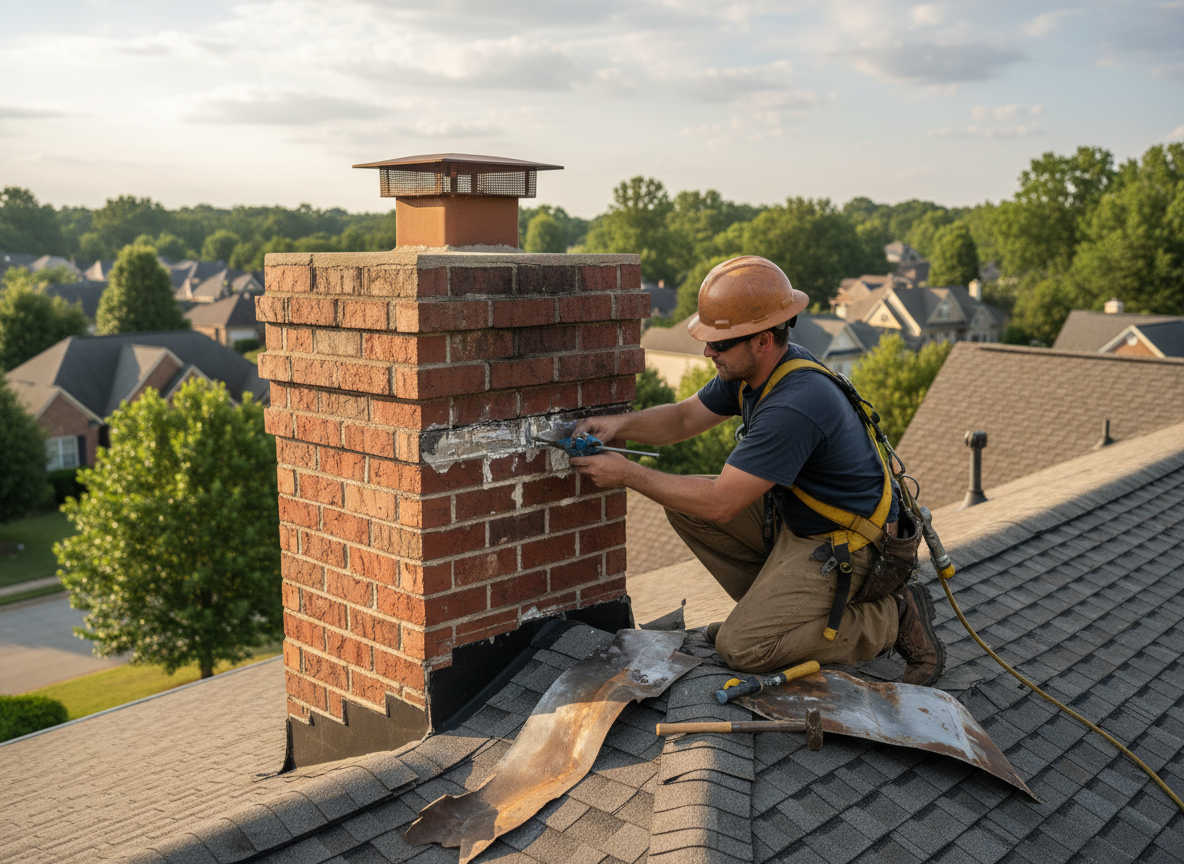
Mint Hill sits in Mecklenburg County where hot humid summers bring frequent thunderstorms that drive water under loose crown mortar and around step flashing on older brick chimneys. Homes in neighborhoods such as Bainbridge and The Farm at Mint Hill often date from the 1980s and 1990s; their clay flue liners and original counter flashing were never designed for the volume of rain Charlotte now delivers in single events. When leaks appear, the first water path is usually the joint between the chimney crown and the flue tile, not the roof membrane itself.
We begin every job by tracing moisture from the attic down rather than assuming the obvious roof intersection. In this climate the mild winters keep mortar joints from fully drying, so small cracks stay saturated for weeks and allow salts to migrate through the brick. That same moisture can rot the double top plate where the chimney passes through the ceiling if left untreated. Proper repair means removing the deteriorated crown, installing a new monolithic concrete cap with a positive slope, and integrating stainless-steel flashing that ties into the existing shingles without relying on caulk.
Edge cases we see regularly include chimneys on split-level homes near Mint Hill Veterans Memorial Park where the roof plane changes three times; each change creates a new leak plane that standard boots miss. We also encounter homes where previous owners added gas-log inserts without sealing the remaining flue area, turning the chimney into a vertical gutter during summer storms. These details determine whether the repair stays at the crown or requires full flue relining and cricket reconstruction.
Seasonal Guidance
Heavy spring and summer rains expose leaks that stay hidden through mild winters. Schedule inspection after any storm that drops more than two inches in twenty-four hours, especially on chimneys facing west where wind-driven rain hits hardest in Mecklenburg County.
Technician insight
In Mint Hill the thing that catches most people out with chimney leak repair is how the heavy summer rains and clay-heavy soil keep the ground saturated for days, pushing moisture up behind the foundation and into the base of older chimneys that were never flashed at the roof deck when the house was built near Charlotte.
Bainbridge Chimney Leak After Storm
Water stains appeared on the ceiling of a Bainbridge home after a series of thunderstorms. Inspection showed the crown had cracked along the flue collar and flashing had pulled away on the west side. We removed the old crown, poured a new sloped cap, and reintegrated stainless flashing into the existing shingles. The homeowner reported no further stains after the next heavy rain.
How it works
- 1
Moisture Path Inspection
We examine the crown, flashing, flue tiles, and attic sheathing from the inside out to locate every active leak point.
- 2
Crown and Flashing Removal
Old mortar and deteriorated flashing are cut away so new materials can tie directly into sound brick and roof decking.
- 3
Monolithic Crown Pour
A new sloped concrete crown is formed and poured with integral drip edge and flue collar to shed water away from the masonry.
- 4
Flashing Integration and Test
Stainless step and counter flashing is woven into the shingles, then the chimney is water-tested before final cleanup.
Pricing
Cost depends on chimney height, roof access, and whether the crown, flashing, or both need replacement; we provide upfront quotes after inspection.