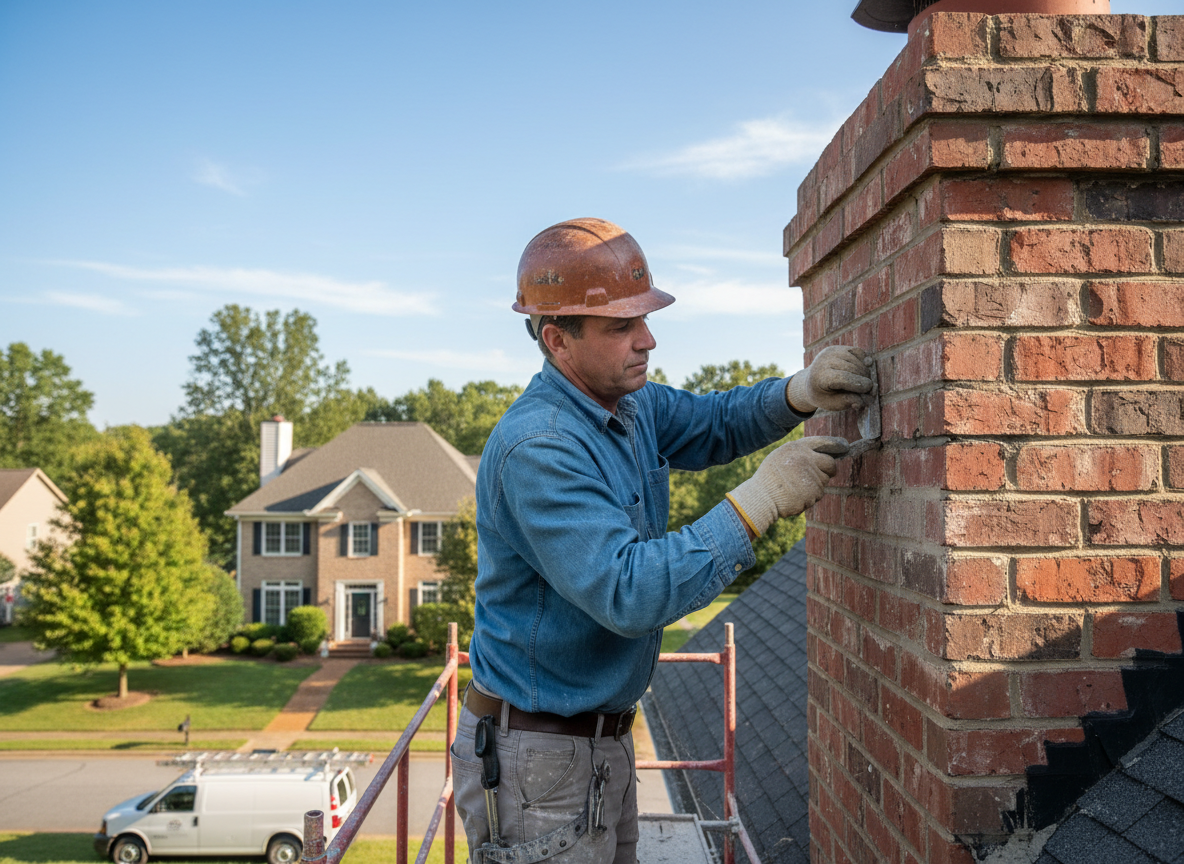
Mint Hill chimneys in neighborhoods like Bainbridge and The Farm at Mint Hill often show failing mortar joints after years of exposure to the region's humid subtropical climate. Hot summers drive thermal expansion while occasional winter dips allow moisture to freeze inside the joints, pushing bricks outward. Tuckpointing removes the deteriorated mortar to a consistent depth, packs fresh mortar that matches the original color and texture, and finishes the joints to shed water away from the brick face.
Homes near Mint Hill Veterans Memorial Park and along Lawyers Road commonly date to the 1980s and 1990s with standard clay brick chimneys that were never designed for today's heavier rainfall patterns. When water penetrates cracked mortar it reaches the flue liner and wood framing, creating hidden rot that only appears after the ceiling stains. Proper tuckpointing uses a lime-based mortar compatible with the softer historic bricks found in older Mecklenburg County stock, avoiding the harder modern mixes that can crack the brick itself.
Charlotte's rapid growth has brought more two-story additions onto Mint Hill homes, changing rooflines and creating new flashing details that funnel water directly onto chimney shoulders. Tuckpointing these areas requires scaffolding on sloped yards common in the area and careful color matching so the repair blends with the existing brick. Skipping the joint profile or using the wrong sand leaves visible stripes that homeowners notice every time they drive up the driveway.
Mecklenburg County building practices often left chimneys with minimal crown slope and no cricket on the uphill side. During tuckpointing we also check the crown and reglet flashing so the newly pointed joints do not become the next leak point after the first heavy summer storm.
Technician insight
In Mint Hill the thing that catches most people out with chimney tuckpointing is the high humidity after we finish. Mortar that looks set can still shrink and crack if a summer thunderstorm hits before it fully cures, especially on the west-facing side that gets the afternoon sun. We always stage the job so the last side we point is the one that stays shaded longest.
Bainbridge Chimney Shoulder Leak
Water stains appeared on the second-floor ceiling after a July storm. Inspection showed open joints on the uphill shoulder where a new addition roof met the original chimney. We removed the old mortar, repointed with matching lime mix, and improved the reglet flashing detail. The ceiling stayed dry through the next three rain events.
How it works
- 1
Site Assessment
Inspect all four sides of the chimney from roof level, checking mortar condition, brick movement, and flashing details specific to Mint Hill roof pitches.
- 2
Mortar Removal
Cut out deteriorated joints to 3/4 inch depth using hand tools to avoid damaging the softer brick common in 1980s Mecklenburg construction.
- 3
Joint Packing
Pack fresh lime-based mortar in layers, tooling each joint to a concave profile that sheds the heavy rain typical of Charlotte summers.
- 4
Final Cure and Check
Protect the work during the humid curing period and return to verify no shrinkage cracks formed before signing off.
Pricing
Pricing depends on chimney height, number of sides requiring work, and whether scaffolding is needed on sloped Mint Hill lots.